Solar panels in series vs parallel calculator
Panels in series add their voltages; in parallel they add their currents. Enter the numbers from your panel’s data sheet and how you plan to wire them — the calculator also checks the cold-morning open-circuit voltage against your charge controller.
Enter your measurements
More options: Controller max Isc
- Array Vmp
- 36 V
- Array Imp
- 5.56 A
- Array power (STC)
- 200 W
- Array Voc at 25 °C (STC)
- 43.2 V
- Array Voc at the coldest temperature
- 48.5 V
- Array Isc
- 6.12 A
- Controller voltage check
- OK — 51.5 V below the 100 V limit
Series adds volts: 18 V × 2 = 36 V; parallel adds amps: 5.56 A × 1 = 5.56 A
Cold Voc per panel = 21.6 V × (1 + −0.35% × (−10 − 25) °C) = 24.25 V × 2 in series = 48.5 V (rounded up)
Quick answers for common sizes
| Example | Answer |
|---|---|
| Two 100W solar panels in series | 36 V × 5.56 A = 200 W (48.5 V cold Voc) |
| Four solar panels in series vs parallel | Two strings of two: 36 V × 11.12 A, 48.5 V cold |
Cold open-circuit voltage at other temperatures
| Coldest expected temperature | Array Voc at the coldest temperature | Controller voltage check |
|---|---|---|
| 50 °F | 45.5 V | OK — 54.5 V below the 100 V limit |
| 32 °F | 47 V | OK — 53 V below the 100 V limit |
| 14 °F | 48.5 V | OK — 51.5 V below the 100 V limit |
| -4 °F | 50.1 V | OK — 49.9 V below the 100 V limit |
| -22 °F | 51.6 V | OK — 48.4 V below the 100 V limit |
Worked examples: two 100W solar panels in series and four solar panels in series vs parallel.
Series vs parallel in one picture
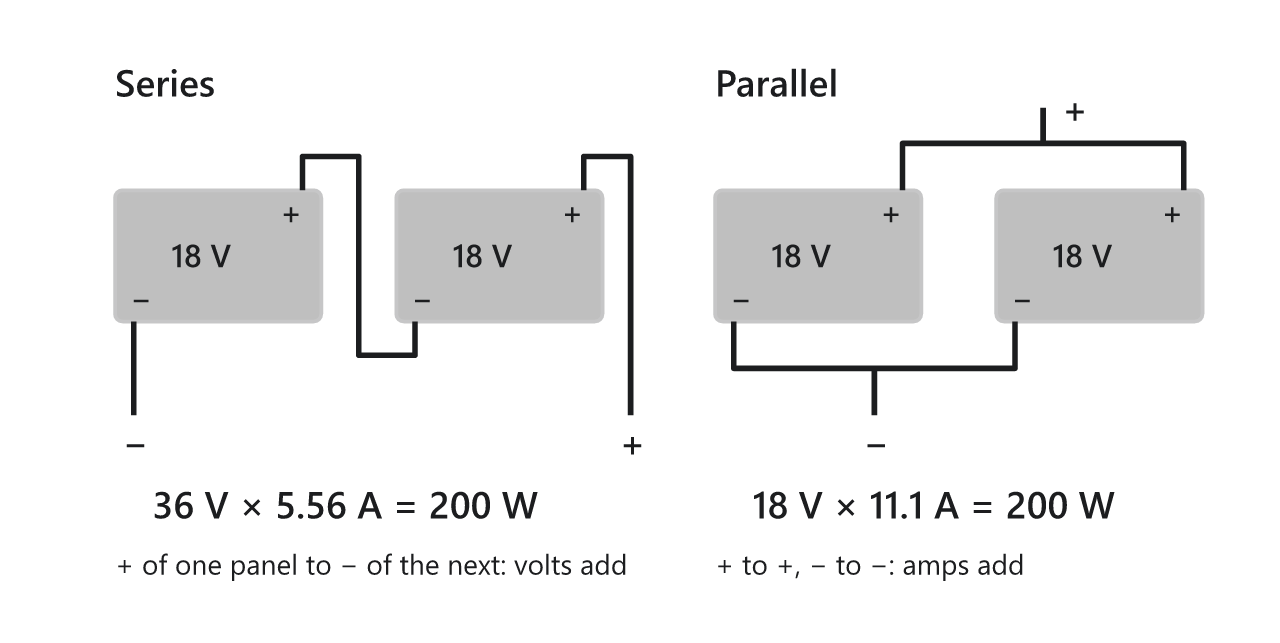
| Series | Parallel | |
|---|---|---|
| Voltage | Adds up (2 × 18 V = 36 V) | Stays the same (18 V) |
| Current | Stays the same (5.56 A) | Adds up (2 × 5.56 A = 11.1 A) |
| Power | 200 W | 200 W |
| Controller | Needs MPPT for a 12 V battery | Works with PWM or MPPT on 12 V |
| Shade | One shaded panel pulls down the string | Shade on one panel affects mostly that panel |
| Cabling | Lower current, thinner cable for the same loss | Higher current, heavier cable |
The formulas
series: array V = panel V × panels in series; array A = panel A
parallel: array A = panel A × strings; array V = panel V
cold Voc = Voc × (1 + coefficient × (coldest °C − 25))
The cold-weather line is the temperature-coefficient method: the panel data sheet gives how much Voc changes per degree away from the 25 °C test temperature, usually as a negative percentage, so voltage rises as the panel gets colder. Victron’s PWM-vs-MPPT paper uses the same method for power and lists −0.35 %/°C for Voc on its example 100 W panel. The highest voltage an array ever sees is its open-circuit voltage on a cold, bright morning — before any current flows — and that is what must stay below the charge controller’s maximum PV input voltage.
Choosing how to wire
- PWM controller on a 12 V battery: wire 12 V-class panels (about 18 V Vmp) in parallel. A PWM controller can’t use the extra voltage of a series string.
- MPPT controller: series strings raise voltage and cut current, which means less cable loss — as long as the cold Voc stays under the controller’s limit.
- Partial shade: if one panel is often shaded (a roof vent, a tree), parallel or smaller strings lose less.
- Mixed panels: panels in series should share the same current rating; panels in parallel should share the same voltage. Mixing different models wastes output.
What you’ll need
- MPPT solar charge controllerMid-range price
Converts a higher panel voltage into charging current, so you can wire panels in series and lose less in the cables. Size it on output amps and maximum PV voltage.
See options on Amazon (opens in a new tab) - MC4 branch connectors (Y splitters)Budget price
Joins panels in parallel without a combiner box for small arrays. Check the connector’s current rating against your total.
See options on Amazon (opens in a new tab) - Digital multimeterBudget price
Reads battery voltage, panel open-circuit voltage and continuity. The first tool to reach for when a solar system is not charging.
See options on Amazon (opens in a new tab)
As an Amazon Associate we earn from qualifying purchases. Links to products are affiliate links — they cost you nothing extra and help keep these calculators free.
Frequently asked questions
Is it better to wire solar panels in series or parallel?
With an MPPT controller, series usually wins: higher voltage, lower current, less cable loss — provided the cold Voc stays under the controller’s limit. With a PWM controller on a 12 V battery, wire 12 V-class panels in parallel. Parallel also copes better with partial shade.
What happens when you put two 100W solar panels in series?
Voltage doubles and current stays the same: with Victron’s example panel, 36 V at 5.56 A at maximum power, and an open-circuit voltage of 43.2 V that rises to about 48.5 V at −10 °C. See two 100W solar panels in series.
Why does solar panel voltage go up in the cold?
A silicon cell’s voltage rises as it cools. Data sheets give the change as a temperature coefficient, typically a few tenths of a percent per °C; colder than the 25 °C test temperature means higher Voc.
Does series or parallel give more watts?
Neither — the same panels make the same watts. Wiring only changes how they are split between volts and amps, which affects the controller you need and the losses in the cable.
Sources
- Victron Energy — Which solar charge controller: PWM or MPPT? (2020) (opens in a new tab) — MPPT output current = panel watts ÷ battery voltage (100 W ÷ 13 V = 7.7 A); a PWM controller pulls the panel down to battery voltage (81 W from a 100 W panel at 25 °C, about the same as MPPT at 75 °C); temperature-coefficient method; example panel Voc 21.6 V, −0.35 %/°C.